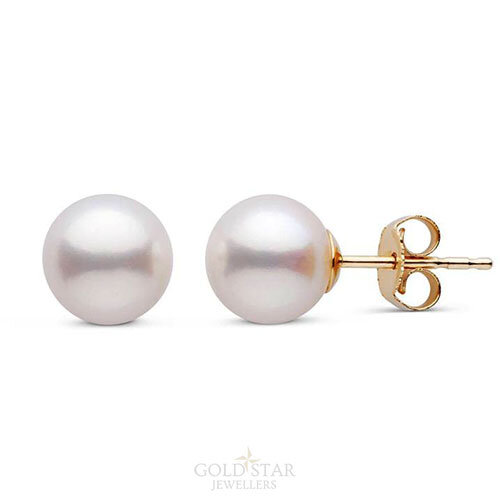
The finest quality of pearls have been considered as gemstones for over 6,000 years.
A pearl is produced in a living bivalve, shelled mollusk, such as an oyster (the most common) or an abalone clam. These hard, round, glistening objects appear inside the soft tissue of a mollusk due to the insertion or introduction of some kind of irritant. Under natural, spontaneous conditions, that could be a grain of sand, a microscopic intruder, or a parasite; while the production of cultured pearls begins with a tissue implant, typically a piece of mantle from a "donor shell".Regardless of the type of irritant, the process is the same: A pearl sac is formed from external mantle tissue cells, then calcium carbonate (the material that composes both the shell and the pearl) and conchiolin (a protein involved in shell formation) is secreted to cover the irritant. This secretion process is repeated many times, thus producing a pearl.
Almost all species of shelled mollusks are capable of producing pearls, yet the majority of pearls on the market today are a product of cultivation under artificial conditions. There are four major types of cultured pearls: Akoya, South Sea, Tahitian, and Freshwater. Natural pearls are extremely rare and, therefore, incredibly expensive relative to cultivated pearls, which are comparatively lower in price.Whether cultivated or sourced in the wild, gem-quality pearls are typically iridescent (or nacreous) due to the nacre that makes up the inner layer of the shell, also known as "mother of pearl". All pearls are evaluated based on their luster, nacre thickness, shape, surface quality, color, and size.
A lab created diamond is a genuine diamond that is man-made in a lab. They are also called synthetic diamonds and these diamonds are in fact real, sharing the same diamond crystal lattice structure as the earth-mined diamonds.
Pulse™ is the hottest Jewellery collection in industry today.
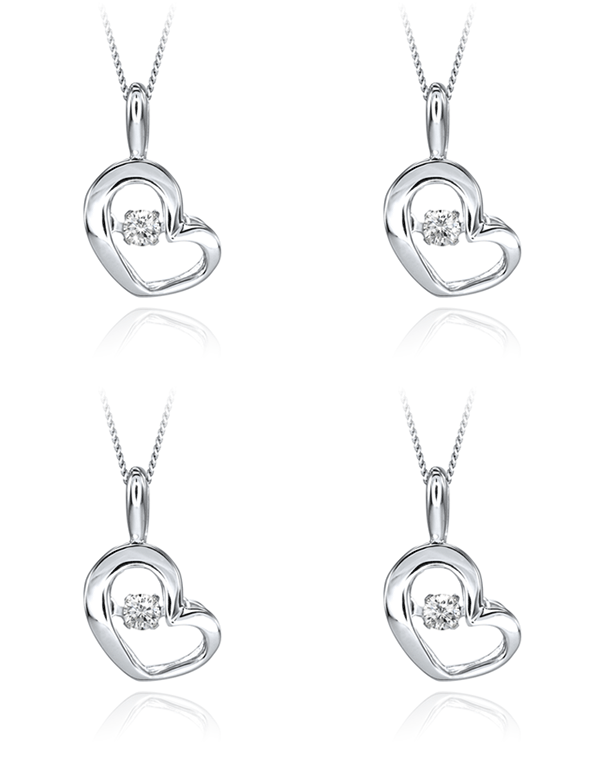
This new and exciting collection features pendants and earrings which have a center stone or cluster of diamonds suspended in the piece of jewelry, and are held together from two sides using a patented design which prevents the center piece from touching the wearer's body and secures the diamond 100%. The center diamond or cluster therefore moves continually in a vibrating fashion thus creating a continual sparkle from the swinging which is achieved by the slightest movement.
Wide selection of gold earrings